Introduction:
You can get electricity from the sun using solar cells. That means it is possible to reduce greenhouse gas production by using electricity from sunlight. But many things can affect the amount of electricity from solar cells. Here are some things that will do that: trees, houses, clouds, time of year, and where you live in the world.
Question:
For this project we want to find out what is the best angle for generating the most electricity using solar cells
Hypothesis:
I think the best angle is when the solar cells are perpendicular to the light source.
Experiment:
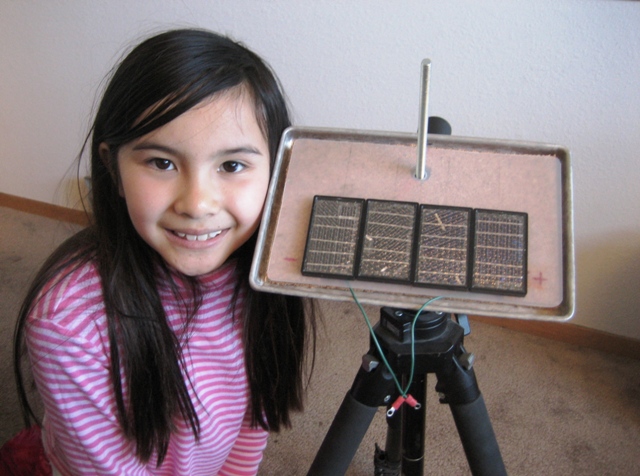
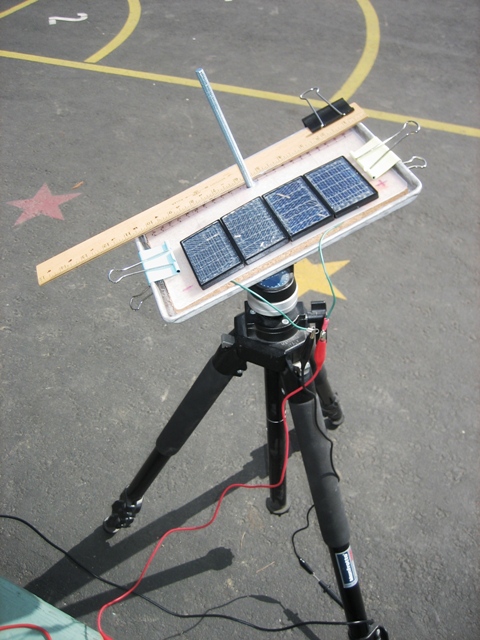
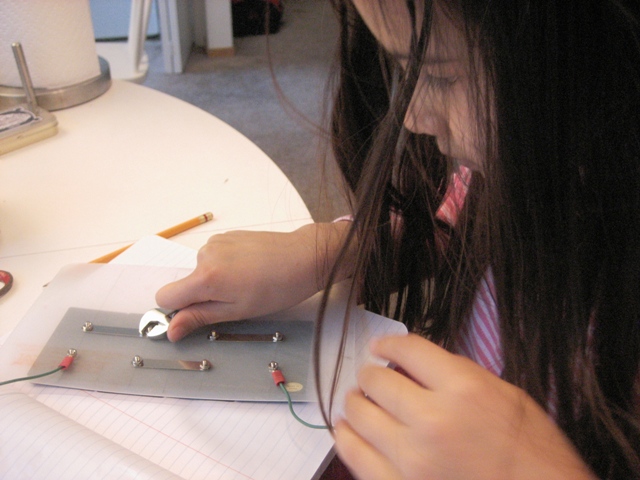
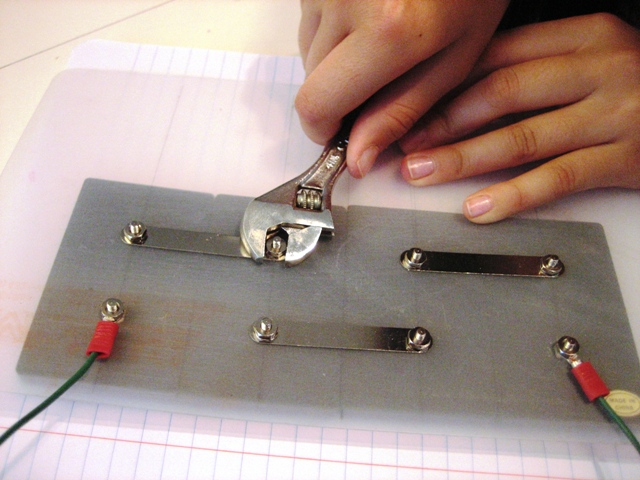
With my dad’s help, we built a test fixture using the following equipment and materials.
Equipment:
- 4 solar cells rated at 0.5 volts each for a total of 2.0 volts
- aluminum cookie sheet (surface mount)
- 2 cork sheets (insulators)
- 1 plastic sheet
- digital volt meter
- 5/16 bolt with two washers and two nuts
- connectors and wires
- wooden ruler
- large clips
- camera tripod with quick release
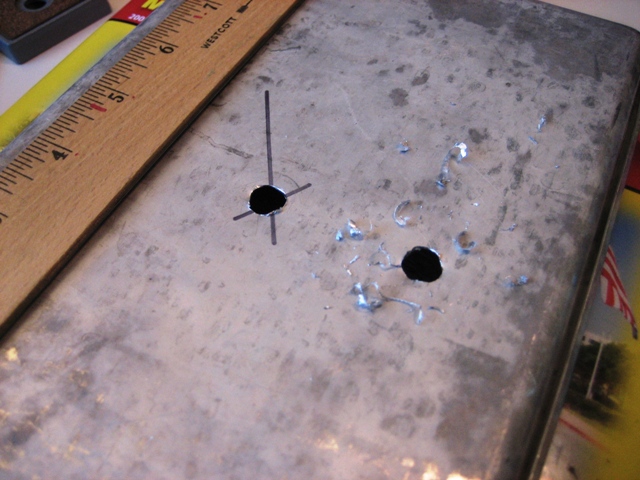
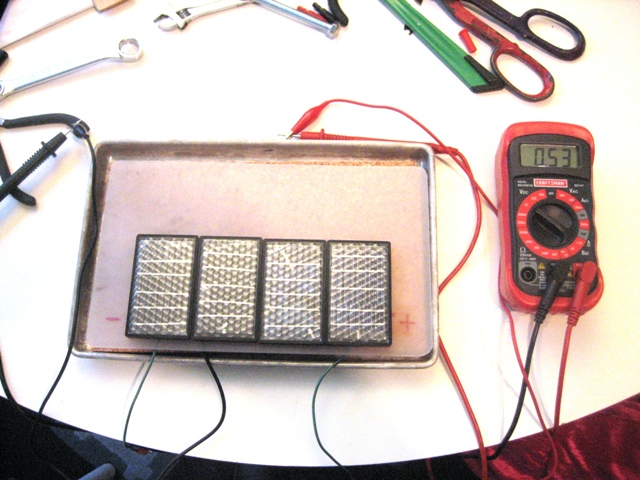
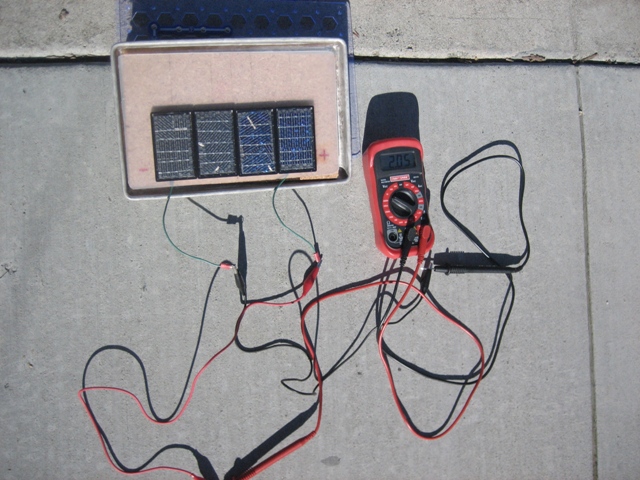
Building the test fixture…
 |
 |
 |
 |
 |
 |
Using some math, my dad knew how to figure out the angle of the sun, α, by knowing the length of the shadow, a, of the bolt sticking out and the length of the bolt, b.
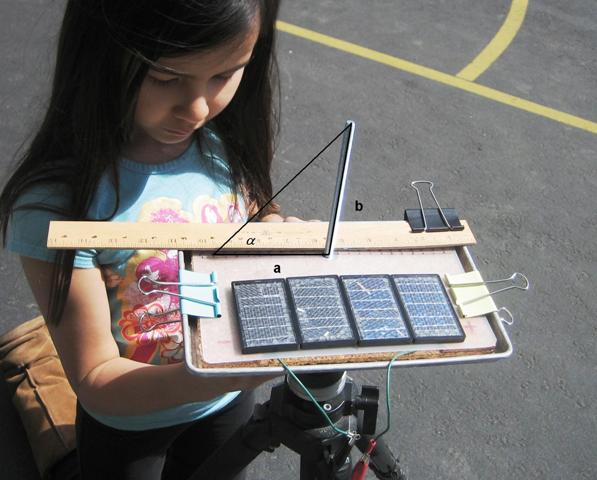
We tried tipping the fixture at different angles using the length of the shadow as a guide. We took measurements of the voltage using the voltmeter for shadow lengths starting from 0″ to 9″ in one inch steps.
Because a post broke off one of the solar cells, I had to remove it from the circuit, which meant we could only get around 1.5 volts (each solar cell was rated at 0.5 volts X 3 = 1.5 volts total) from the 3 remaining solar cells. Sometimes, clouds would cast a shadow on the array so we would have to wait for the cloud to pass. And the sun moved so I would have to reposition the array often.
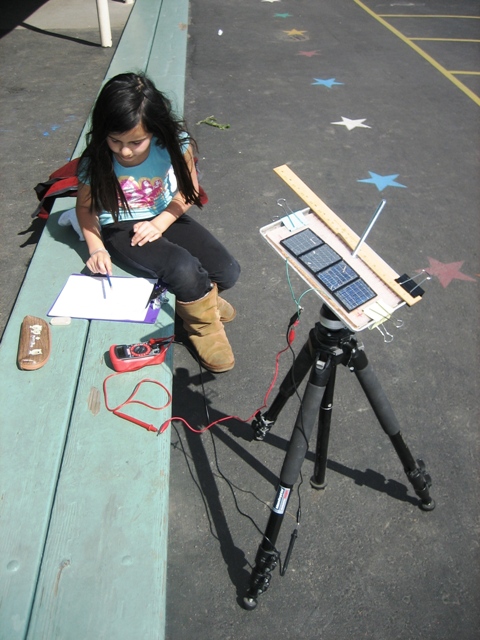
My dad calculated the angles, average voltage, and standard deviation.
Results:
| Shadow Length (in) | Angle (deg) | A | B | C | D | E | F | G | H | I | Avg | Std Dev |
| 0.0 | 90.0 | 1.48 | 1.57 | 1.54 | 1.52 | 1.53 | 1.52 | 1.54 | 1.54 | 1.53 | 1.53 | 0.0240 |
| 1.0 | 78.8 | 1.54 | 1.58 | 1.54 | 1.52 | 1.54 | 1.53 | 1.53 | 1.54 | 1.54 | 1.54 | 0.0166 |
| 2.0 | 68.4 | 1.59 | 1.58 | 1.54 | 1.52 | 1.53 | 1.54 | 1.53 | 1.53 | 1.53 | 1.54 | 0.0245 |
| 3.0 | 59.3 | 1.56 | 1.57 | 1.54 | 1.50 | 1.53 | 1.54 | 1.52 | 1.52 | 1.52 | 1.53 | 0.0218 |
| 4.0 | 51.7 | 1.55 | 1.53 | 1.53 | 1.49 | 1.51 | 1.52 | 1.50 | 1.51 | 1.51 | 1.52 | 0.0180 |
| 5.0 | 45.4 | 1.48 | 1.49 | 1.52 | 1.48 | 1.50 | 1.50 | 1.49 | 1.49 | 1.49 | 1.49 | 0.0122 |
| 6.0 | 40.2 | 1.49 | 1.51 | 1.51 | 1.48 | 1.48 | 1.48 | 1.46 | 1.47 | 1.46 | 1.48 | 0.0186 |
| 7.0 | 35.9 | 1.51 | 1.50 | 1.48 | 1.46 | 1.46 | 1.46 | 1.44 | 1.45 | 1.44 | 1.47 | 0.0250 |
| 8.0 | 32.3 | 1.47 | 1.47 | 1.46 | 1.44 | 1.42 | 1.42 | 1.41 | 1.42 | 1.42 | 1.44 | 0.0240 |
| 9.0 | 29.4 | 1.46 | 1.45 | 1.43 | 1.40 | 1.39 | 1.39 | 1.38 | 1.38 | 1.38 | 1.41 | 0.0316 |
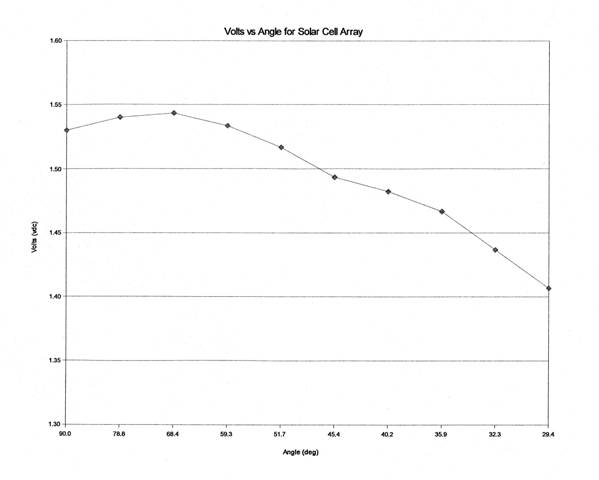
We made a graph of the average voltages at the different angles and got a conclusion.
Conclusion:
Based on the data I collected, when the angle gets steeper, the amount of electricity coming into the solar cells goes down and it looks like when the angle is about 90 degrees, meaning that the solar cell array is perpendicular to the sun, it gets the most light and gets the most volts.
References:
http://www.engineeringinteract.org/resources/siliconspies/flash/concepts/simplecircuits.htm
http://www.can-do.com/uci/lessons99/electricity.html
With some simple trig we were able to convert the length of the shadow and the length of the probe into the angle of the sun with respect to the solar array. Angle in degrees = 180 x (arctan(a/b) / pi.