AUTHORS: Bovril and Radiance
STATUS:Completed
This project is to develop a social network and submit it as a science fair project. The topics covered includes: social sciences (social network analysis), math (graph theory, statistics and matrix operations), and communication. Part of the objective will be to discover the alphas and cliques within a limited network of friends and acquaintances (no actual names will be used).
INTRODUCTION
People are, by nature, social animals. This is of such importance that their connections and relationships, their social network, defines who they are. Families, clubs, church groups and friend circles are examples of social networks. In fact, any activity where people have to come together and do something as a group can become a social network.
Recently, many websites have been created to utilise the social nature of humans. For example: Facebook, LinkedIn, Amazon.com and Ebay and even Schoology, allow people to
- find each other
- share ideas
- share likes and dislikes
- share experiences and photos
- allow business to market their products
and so many more.
BACKGROUND
This project is about discovering the characteristics of a particular social circle – a small sample of students and how they connect with each other and about what they might like and how they could become friends through common interests (likes). To be clear, none of their real names will be used in this experiment.
A graph is a mathematical concept made of vertices (nodes) and edges (relationships). They can be fairly simple or extremely complex. They have very interesting characteristics and are used in many different ways to model all kinds of things and their relationships. They are extremely useful for solving many types of problems from traffic patterns to marketing strategy.
There’s a lot of material written about how social networks can be studied using the mathematics of graphs. This has become a popular area of research today, as large social networks are being created and grown so rapidly.
OBJECTIVE
Learn how graphs as a topic in mathematics can be used in social networks to discover interesting and useful information.
HYPOTHESIS
Using social networks, can we find the cliques, friends and potential new friends through common likes? Can we show that graphs are useful to help figure out these things?
TOOLS AND METHODS
The tools we used included: a graph database software, spreadsheet and survey forms for collecting the data.
1. Design and build a model of a social network using a graph.
- Create students and activities (vertices)
- Define relationship (edges)
- Using a survey, add the students, their friends and their likes (what activities they like to do)
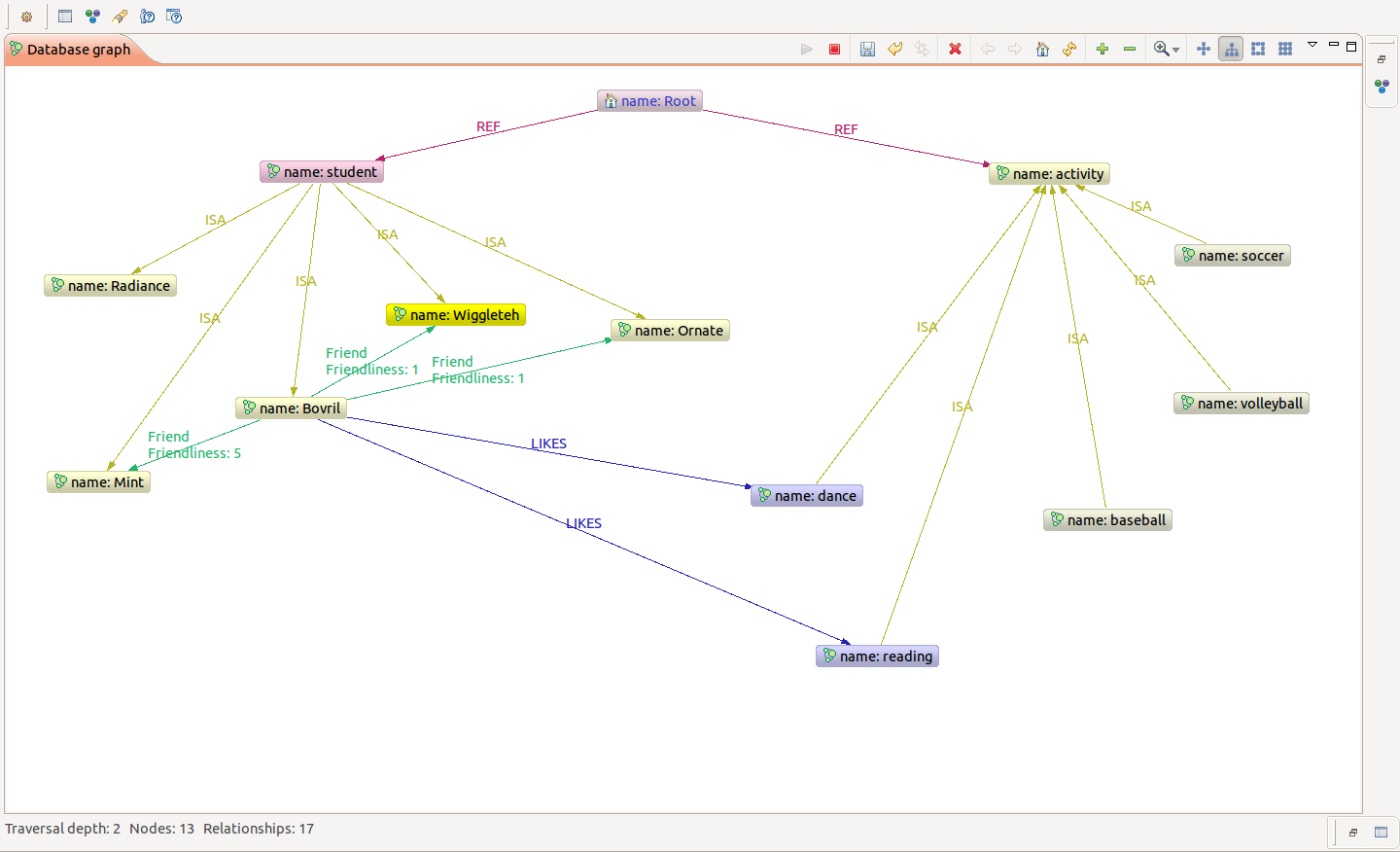
2. Collect data using this questionnaire: Survey Questionnaire and enter the data into the graph. We limit the survey to the level of friends of friends starting with us, in other words, 3 levels friendship so we have enough data but not enough to overwhelm us. We’re not trying to research the entire 6th grade class.
3. Using a spreadsheet we analyse the graph and find the simple degree centrality of the different students and activities. Depending on the question we want to answer, we might use a modified degree centrality to find the students who might have the most influence – the alpha. We’ll figure out how many connections they have, then sum the friendliness factors and multiply. The highest score will be the alpha. We’ll do the same thing to find the most popular activities (without the friendliness factor). And we’ll just look at the graph to find any cliques (cycles). We’ll also just do simple matching of potential friends by looking at the graph and figuring out students who have many likes in common but are not yet friends.
EXPERIMENT
Survey
We collected data from 30 different students and build a graph of them and their friends. We were able to record a “friendliness”, a rating of their friendship from 1 to 5. We also got their likes of 8 different activities: volleyball, soccer, dance, swimming, drama, baseball and lacrosse.
Analysis
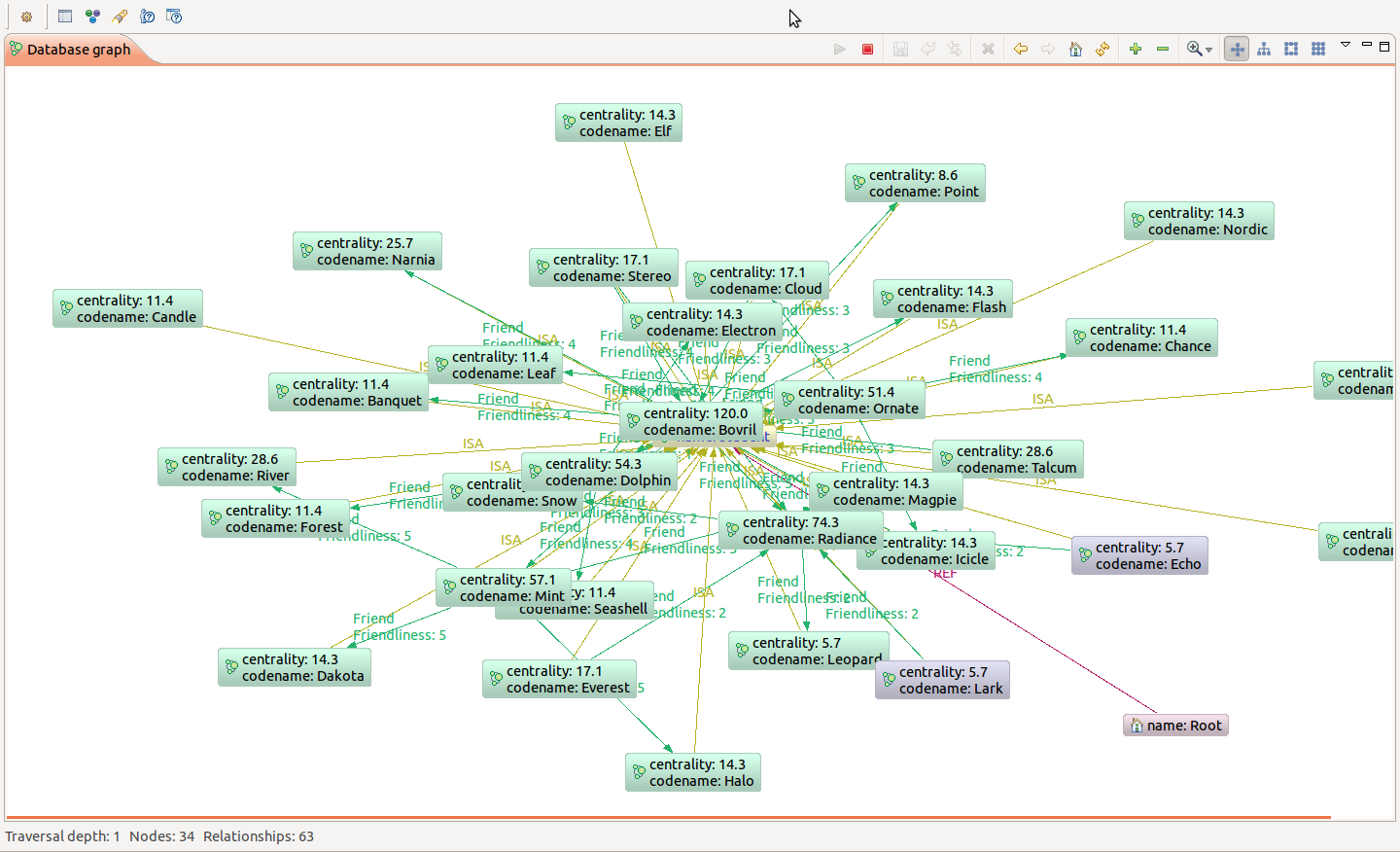
We ended up using a unique centrality, which we call the “Bovril-Radiance” (B-R) centrality. It basically takes the average of the “friendliness” and multiplied it by a hundred. We used a thing called an adjacency matrix to figure out the B-R centrality.
My Social Network
Likes
| activity | degree centrality |
| volleyball | 13 |
| dance | 9 |
| soccer | 6 |
| drama | 5 |
| baseball | 3 |
| reading | 2 |
| swimming | 1 |
| lacrosse | 1 |
CONCLUSION
Using the “Bovril-Radiance” centrality, we were able to figure out who had the best friends. It turned out to be Bovril (120.0) with Radiance (74.3), Mint (57.1), Ornate (51.4) and Dolphin (54.3) in the top group. This suggests they were the most influential students in this group. The results are a little bit not right because the researchers were part of the experiment, so they had a better opportunity for linking up their friends than the other subjects. If they are removed from the graph, the graph might be more realistic and not so heavily centered around Bovril.
We were also able to find the most popular activity. It was volleyball scored 13 while dance came in second at 9. Most likely, because so many students liked volleyball, they might be able to form friendship by their interest in volleyball. New friends might be able to form from these common interests, specially volleyball and dance.
This is actually an important project because it is so relevant to our culture and there’s enormous focus on this topic.
Does your social network represent the entire 6th grade class? Why? Why not?
How will you decide the most influential student is? Can you use degree centrality? Or maybe some modified version of it?
I still don’t see much in the way of detail…how are you going to conduct this experiment?
What is the data you’ll need to figure out your hypothesis?
GREAT JOB! You guys pulled it off!